The frontier labs have started talking like governments. The most important technology in human history. Compute programs the size of a national infrastructure budget. Meetings with heads of state, conducted as though between equals. Bans, unbans and fear mongering…
I build on top of these companies for a living, so I am not sneering at the ambition. Take it seriously and a smaller question follows, one that nobody at that altitude seems to bother asking.
Who owns them?
I went looking, expecting the answer to be complicated. It took an afternoon, and most of that was me double-checking because I did not quite believe it. Sitting near the top of the shareholder register at almost every company at the centre of the AI boom is a firm that trains no models, attends no safety summits, and employs nobody whose job is to worry out loud about the end of the world. It files a 10-K. You can buy a piece of it before lunch. The ticker is BLK.
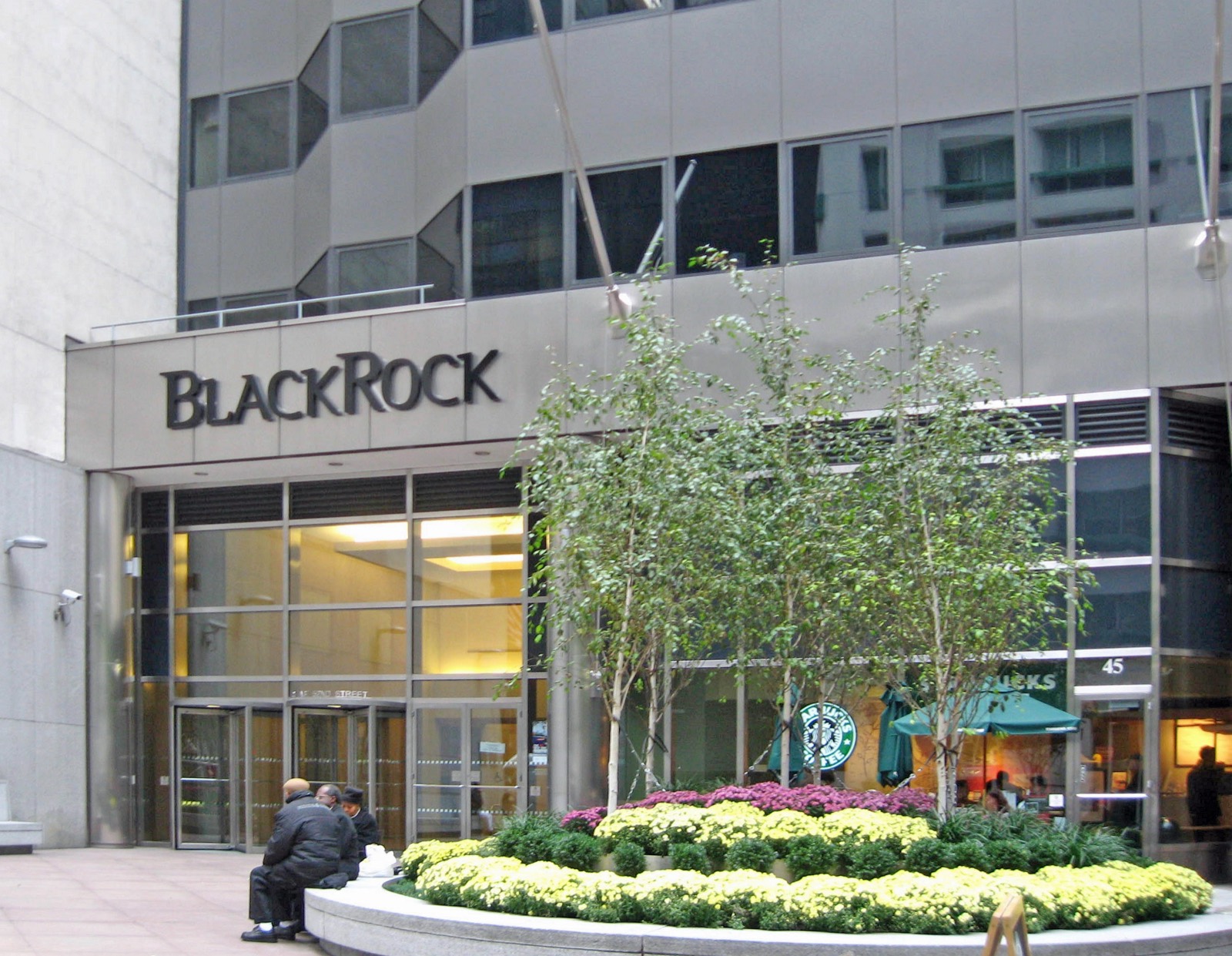 BlackRock No product on a shelf, no keynote, no launch event, no titans of change and more financial assets sitting behind that door than any institution in history has held.
Photo: public domain, via Wikimedia Commons.
BlackRock No product on a shelf, no keynote, no launch event, no titans of change and more financial assets sitting behind that door than any institution in history has held.
Photo: public domain, via Wikimedia Commons.

The wrong screen
Our mental picture of a machine quietly running the world comes from one place. Skynet, in Terminator, boots up one afternoon, works out that it is everywhere at once, and decides it no longer needs us. So we watch datacenters, waiting for something to open its eyes.
Something with that reach does already exist. It has been assembled since 1988, it is not artificial intelligence, and there is nothing automatic about it. It is a firm, run by people, that has ended up holding decision rights over more of the world’s productive assets than any institution before it.
I should say this before going further, because the genre rots the brain. “BlackRock secretly runs the world” is the house style of a thousand videos with red string on the thumbnail, and I went in expecting to debunk it. Mostly I did. The conspiracy falls apart the moment you open a filing.
What is left when the nonsense burns off is more boring than the conspiracy, all of it public, and yet worse than the conspiracy, because a conspiracy at least has someone in charge of it and this does not. That took me a while to sit with.
Start with size, since nobody argues about that part. $15.3 trillion as of the June quarter, a filed number in an 8-K, not something off a forum. Three years ago it was $10 trillion. Nothing in the history of money has climbed at that slope, and the thing lifting it is not talent. It is a default setting on other people’s retirement accounts.
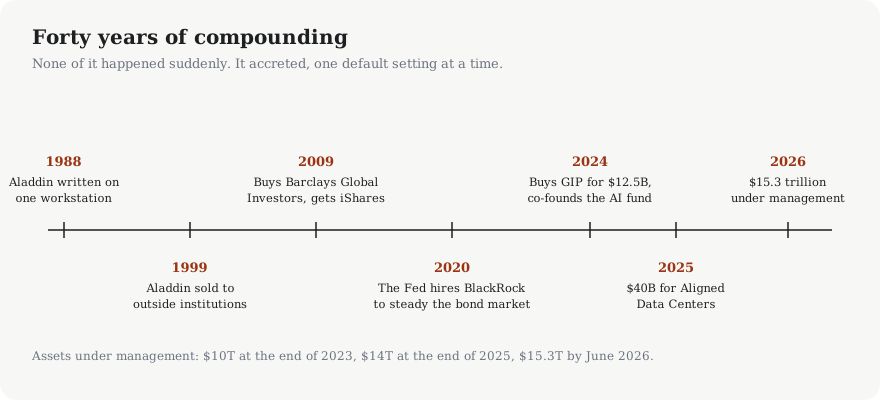 Forty years of small, individually reasonable decisions. Not one of them looks like a takeover on the day it happens.
It already owns whatever it is you are afraid of
Pick the company that worries you. NVIDIA, because the chips are the bottleneck. Microsoft, because it rents intelligence to every enterprise with a procurement department. Apple, Alphabet, Amazon, Meta, because they reach half the planet by Thursday.
Pull up the shareholder register on any of them. I went through them one at a time, expecting a mess of different names. There is no mess. Vanguard first, BlackRock second, State Street third. Next company, the same three. The one after that, the same.
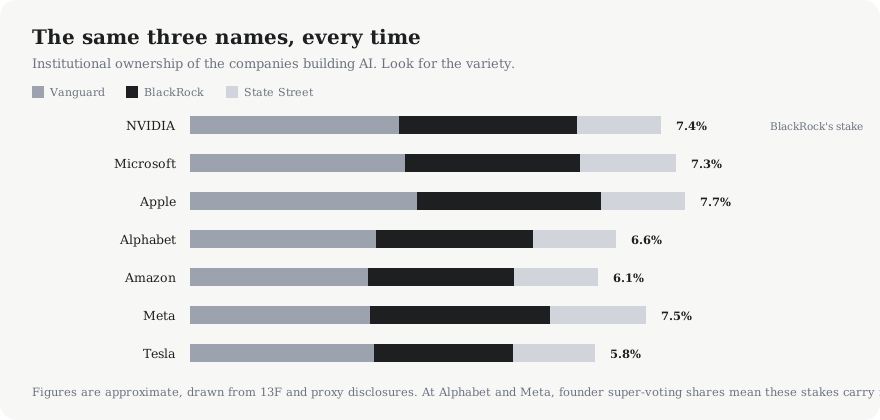 Seven companies at the center of the AI build-out. The register barely changes between them.
BlackRock on its own holds around 7% of Microsoft, close to 8% of Apple, roughly 7% of NVIDIA. Put the three firms together and they own more than a fifth of the average S&P 500 company and cast about a quarter of the votes in its board elections. Those last two numbers belong to Lucian Bebchuk and Scott Hirst, who named the trio the Giant Three in 2019 and projected their combined vote heading toward 40% inside two decades.
Two honest asterisks. At Alphabet and Meta the founders hold super-voting stock, so BlackRock owns the economics without the control. And it does not own any of this the way you own your house. It holds the shares for clients, a qualifier that carries more weight than anything else here, and I will come back to it.
How the stake got that big
Nobody sat in a room and decided BlackRock should own a piece of everything. The position accumulated.
An index fund is the dumbest machine in finance. Money arrives, and it buys every company in the index in proportion to how large that company already is. Nobody reads a balance sheet. Nobody forms a view. When a company doubles, its weight doubles, so tomorrow’s money buys twice as much of it, which lifts it again.
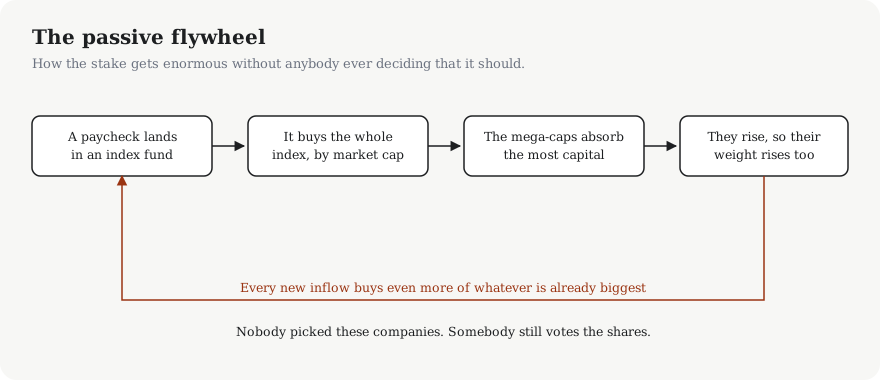 Nobody chose these companies. The weighting rule chose them, funded by everyone’s paycheck. What happens to the shares afterwards is a separate question with a very different answer.
Which is, to be fair, a good deal. Active managers charged more and picked worse. Passive investing is one of the few genuinely good things ordinary savers have ever been handed, and I am not going to pretend otherwise to make a point land.
But notice what the mechanism decides and what it does not. It decides what gets bought. It says nothing about what happens next. The buying is automatic; the shares it piles up are not inert. Every one carries a vote and a meeting management has to take seriously. The rule gathers the ammunition, and people decide where to point it. There is even a twist in BlackRock’s favour: an index fund can never sell, which makes it a shareholder management has to live with forever.
The shared brain
The second layer earns the comparison, and somebody named it after a Disney film.
Aladdin began in 1988, the year the firm was founded, as a bond risk model on a single Sun workstation that sat, in the story everyone repeats, between the office fridge and the coffee machine.
It is now the risk system for a large slice of institutional finance, though pinning down how large is harder than it should be. The last figure BlackRock disclosed itself was in 2018: more than $18 trillion across 210 institutions. Nothing since. The $21 trillion everyone quotes, including people who should know better, traces to press reporting in 2020, not to any disclosure. A company that reports its own assets to the dollar every ninety days has quietly stopped saying how much of everyone else’s money it can see.
What it does all day is manufacture futures that have not happened yet. Monte Carlo simulation, huge numbers of randomly drawn scenarios, tens of thousands of portfolios stress tested against a pandemic or another Lehman. Some of it runs on about 6,000 computers in a data center in Wenatchee, Washington, a fruit-growing town on the Columbia River. The risk brain of global finance, sitting out past the apple orchards.
Here is where most write-ups get it wrong. Aladdin does not trade. It is decision support. Portfolio managers, risk officers and trustees read what it tells them, and then people decide. There is a human in the loop at every institution on the list. And that, not automation, is the whole point. If you want influence over thousands of professional investors, you do not take their hands off the wheel. You supply the instruments they steer by: what counts as risk, how exposures group, which scenarios run, what turns red on a Monday morning. Everyone makes their own call. An enormous number of them make it looking at the same picture, drawn by one company.
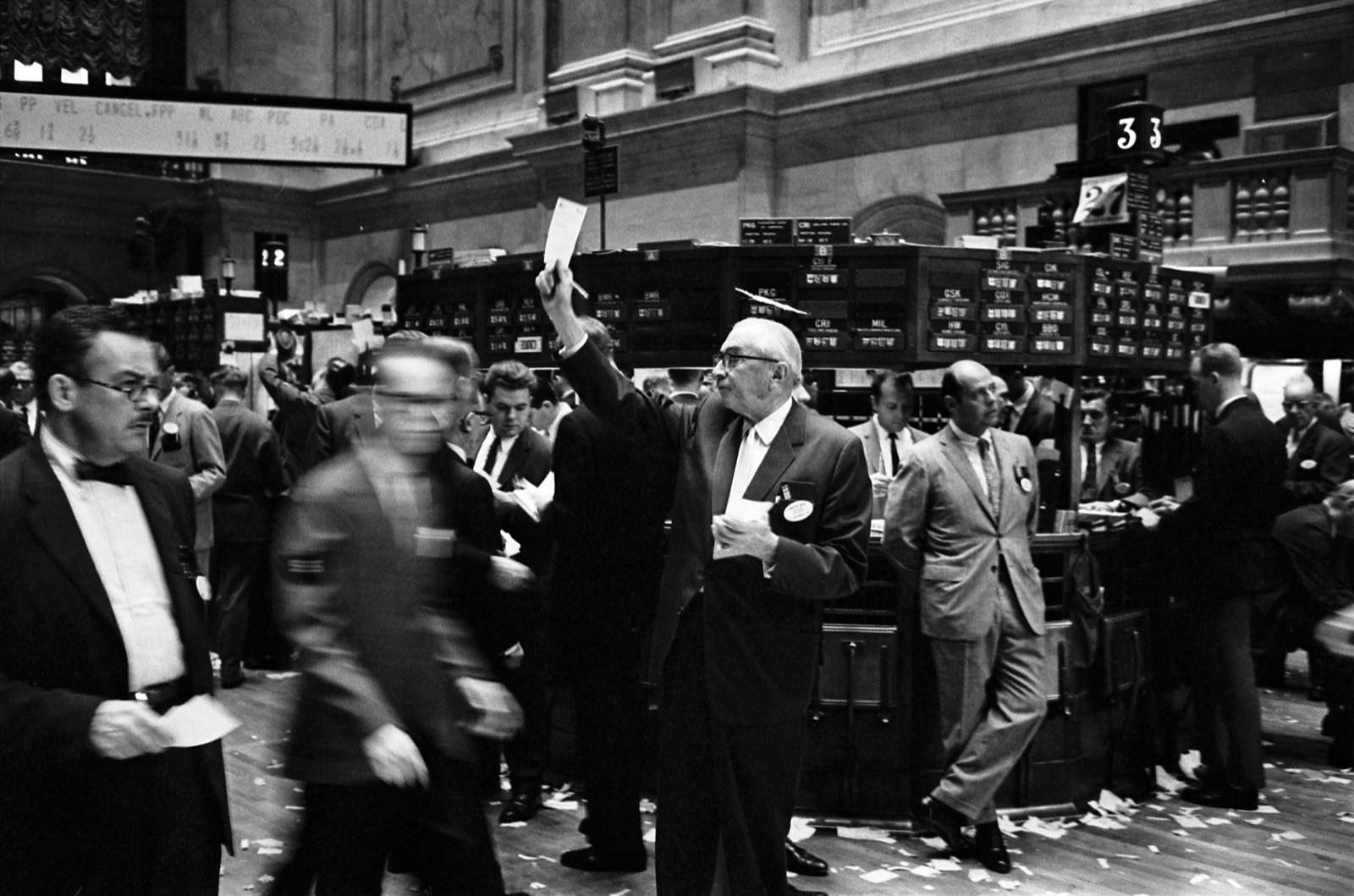 The floor of the New York Stock Exchange in 1963, when a few thousand people formed a few thousand separate views. There are still people making the calls today. Fewer of them, looking at far fewer screens, drawn by one vendor.
Photo: public domain, via Wikimedia Commons.
The floor of the New York Stock Exchange in 1963, when a few thousand people formed a few thousand separate views. There are still people making the calls today. Fewer of them, looking at far fewer screens, drawn by one vendor.
Photo: public domain, via Wikimedia Commons.

Who runs on it is the rest of the point. Not only BlackRock, but its direct competitors, pension funds, insurers, sovereign funds, central banks. CalPERS puts about $260 billion through it. And the best evidence for how good it is comes not from the marketing but from the list of people who have had to phone them.
Aladdin was built on the hardest thing in finance to price: complex fixed income, the mortgage-backed alphabet soup nobody else could value. In 1994 General Electric could not work out what a mortgage book it was holding was actually worth, and hired BlackRock to tell it. That set the template. When the crisis hit in 2008, the US government and a queue of collapsing institutions needed someone to analyze and unwind the toxic assets on the books of Bear Stearns and AIG, and BlackRock got the job, managing a $130 billion unwind.
Sit with that. The institutions that owned the assets could not price their own balance sheets. An asset manager could, because it had spent twenty years building the model that could.
It happened again in 2020. When the bond market seized, the Federal Reserve and the European Central Bank both hired BlackRock to run their bond buying, and the conflict was as sharp as it sounds: while the Fed’s purchases ran, BlackRock’s own corporate bond ETF took in $4.3 billion of new money. Vanguard’s took $33 million.
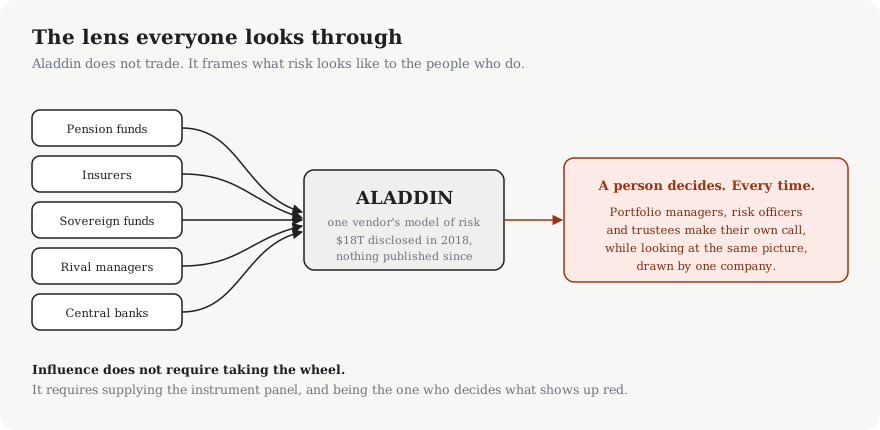 Nobody’s hands come off the wheel. One firm just supplies the instrument panel, including to its own competitors and to several central banks.
Regulators have circled this twice and backed off both times. A decade ago they weighed labelling the biggest asset managers systemically important, the way they treat big banks, and let it drop after BlackRock lobbied. When the EU published its list of nineteen critical technology providers in November 2025, it named Amazon, Microsoft, Google, Oracle, even Bloomberg and LSEG’s risk arm. So an analytics provider can be named. The platform that tells much of finance what its risk is was not on it.
Then it started buying the floor
This is the part that actually moved me.
A model stays an abstraction until you remember it is a shed full of chips drawing the power of a mid-sized town. Somebody owns the shed. Somebody generates the power.
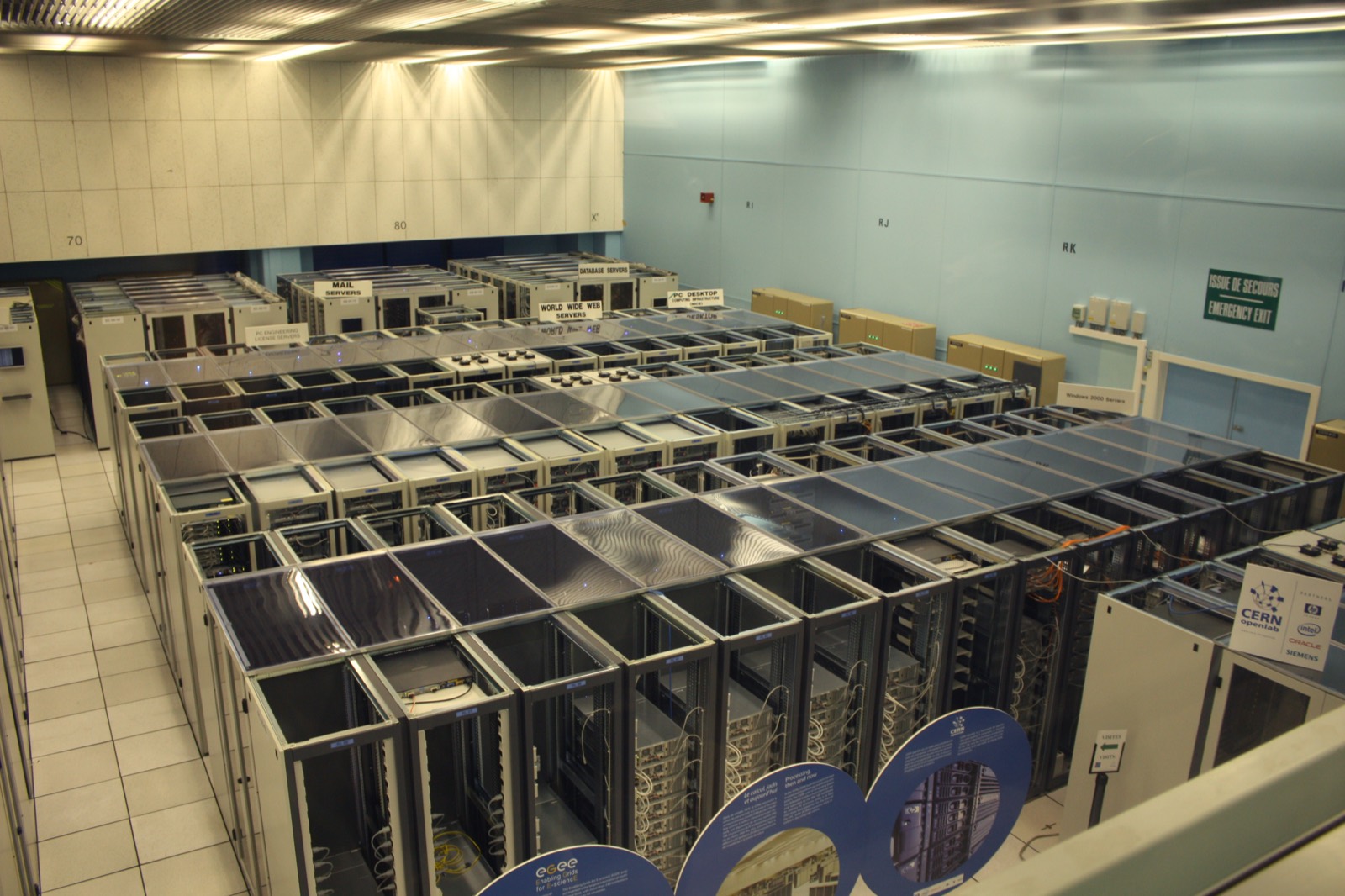 Whatever you believe about machine intelligence, this is the physical shape it takes, and somebody holds the deed to the room.
Photo: Hugovanmeijeren, CC BY-SA 3.0, via Wikimedia Commons.
Whatever you believe about machine intelligence, this is the physical shape it takes, and somebody holds the deed to the room.
Photo: Hugovanmeijeren, CC BY-SA 3.0, via Wikimedia Commons.

In 2024 BlackRock co-founded a vehicle now called the AI Infrastructure Partnership, with Microsoft, NVIDIA and Abu Dhabi’s MGX, aimed at up to $100 billion for data centers and the electricity to run them. In 2025 it bought Aligned Data Centers for roughly $40 billion, the largest digital-infrastructure deal on record. All of that sits on top of the $12.5 billion it paid for Global Infrastructure Partners, which pushed its infrastructure arm past $170 billion in ports, pipelines, grids and generation.
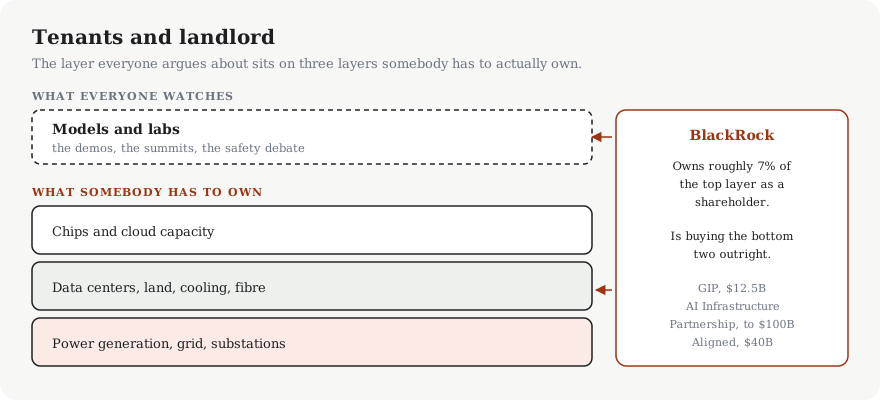 The layer everyone argues about sits on three layers somebody has to actually own. BlackRock holds a slice of the top as a shareholder and is buying the bottom outright.
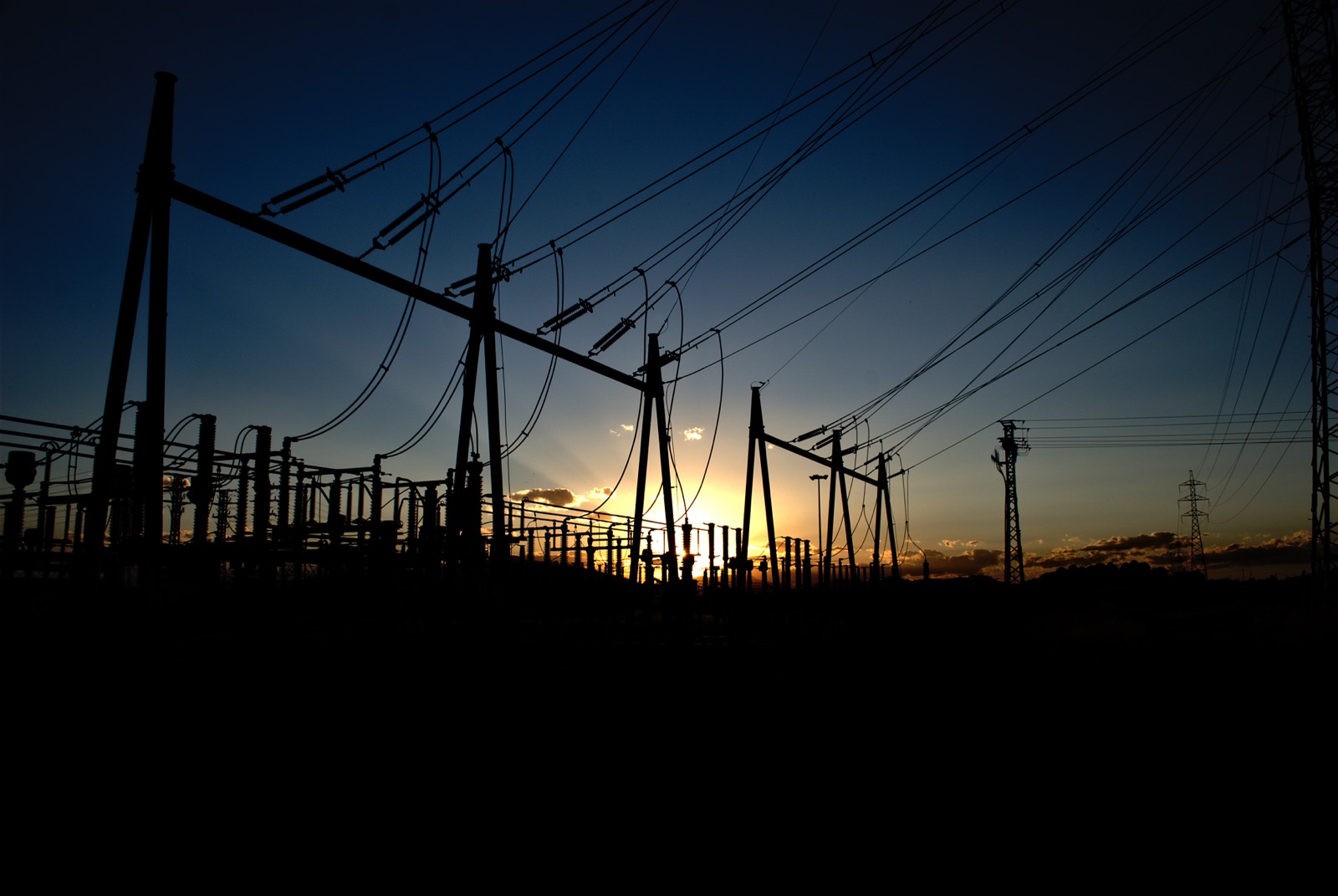 BlackRock’s own analysts reckon the US needs something like 150 additional gigawatts by the end of the decade to feed the data centers. The firm intends to own a good deal of the answer.
Photo: Salth Vader, CC BY-SA 2.0, via Wikimedia Commons.
BlackRock’s own analysts reckon the US needs something like 150 additional gigawatts by the end of the decade to feed the data centers. The firm intends to own a good deal of the answer.
Photo: Salth Vader, CC BY-SA 2.0, via Wikimedia Commons.

So the labs are tenants. They rent compute in buildings owned by someone else, drawing power from grids owned by someone else, while a slice of their own equity sits with that same someone else. Fink, asked whether the Aligned price implied a bubble, said the country needs these investments if it wants to lead in AI. He is right, which is the part that makes it work. The same pattern runs through defense, where BlackRock sits near the top of the register at the makers of the F-35 and the Patriot. Index positions, not a decision to back the arsenal, but somebody at BlackRock still votes them.
The people who are actually driving
Here is where the conspiracy version and the real one separate, though not in the direction the debunkers expect.
Go looking for the owner. BlackRock’s largest shareholder is Vanguard, its closest competitor, holding around 9% through Vanguard’s own index funds. Its second largest is BlackRock itself, because it sits in the S&P 500 and every BlackRock S&P 500 fund is obliged to buy BlackRock. State Street is in there too. The owners of the thing that owns everything are the other things that own everything, plus itself.
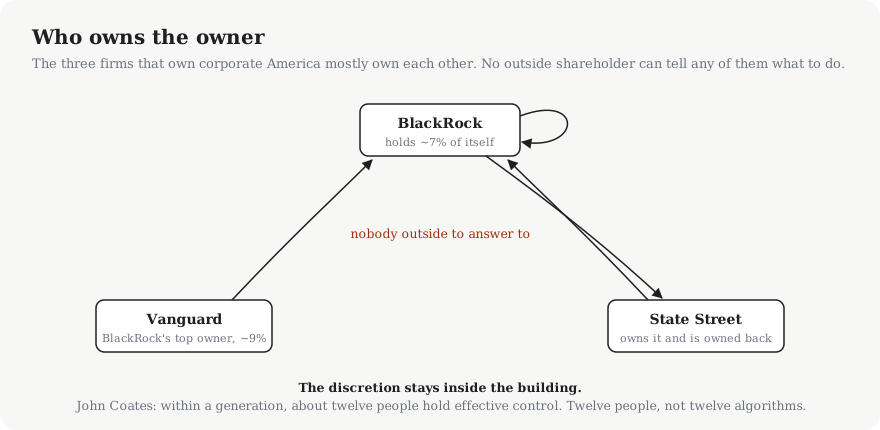 Read the loop as absolution if you like. The other reading is that no outside shareholder has the standing or the appetite to tell any of them what to do, so the discretion stays inside the building.
And the discretion gets exercised by a startlingly small number of people. BlackRock publishes the figures itself, in a stewardship report almost nobody reads. The team is “more than 60 professionals.” In 2025 those sixty-odd people voted at 12,389 companies across 53 markets, on 154,644 separate proposals, and met management 2,373 times.
Sixty people. Twelve thousand companies. About 200 companies each, roughly ten proposals a person a working day, in a calendar where most annual meetings pile into the same three months. BlackRock employs around 24,900 people. Sixty of them vote the shares.
To be precise, since the sloppy version is easy to knock over: it is a hybrid. Routine items are voted by an outside vendor following BlackRock’s written guidelines; anything contentious goes to an analyst. Nobody reads 154,644 resolutions. But people write the rulebook and take every contested call, which is the part that matters.
John Coates, a Harvard law professor and former SEC general counsel, put a number on where this goes in a book called The Problem of Twelve: within a generation, about a dozen people running the index and stewardship desks at a few firms will effectively control the governance of nearly every large US public company. Read the stewardship report and the projection looks conservative. In 2009 that team had sixteen people on it.
Twelve people. Not twelve algorithms.
It is not theoretical. In 2021 an activist fund holding 0.02% of ExxonMobil put three directors on its board, over the objection of one of the most powerful managements in America. It worked because BlackRock, Vanguard and State Street voted for it. BlackRock alone voted 282.8 million shares; the dissidents’ winning margin was about 72.7 million. A decision taken in one building was several times the size of the whole result.
Larry Fink owns about a quarter of one percent of BlackRock. That does not make him a puppet master, and it does not make him powerless; his power is positional, and comes from sitting where the votes are counted. Charlie Munger, no one’s conspiracist, called the index managers a new bunch of emperors. He meant the people who vote the shares.
What it cannot do
I would rather be accurate than dramatic, so here are the limits, and they are real.
BlackRock is a fiduciary. The money is not its own, and that is the legal position, not a talking point. Since 2022 it has been handing votes back: under Voting Choice, clients holding roughly a quarter of its eligible index equity now direct their own proxies, and the pilot has reached retail. The picture of BlackRock voting every board by fiat is out of date, and gets more so each year.
It gets pushed around, too. When Fink leaned into climate, red-state treasurers pulled some $13 billion, and he stopped saying the letters ESG in public. In late 2024 Texas led a group of states suing the Big Three under antitrust law over their shared ownership of coal producers; the Trump administration’s own agencies backed the states, and in early 2026 Vanguard settled for $29.5 million and a retreat from its climate commitments. BlackRock is still fighting, and calls it baseless. And it fails in ordinary ways too: it bought Stuyvesant Town for $5.4 billion in 2006 and defaulted four years later, wiping out investors down to the Church of England.
Then notice what all of that shares. Every limit is political or legal, imposed from outside, after the fact, by people who had to organize to impose it. None is structural. Nothing in the architecture slows the position down. Texas can sue, a governor can pull a mandate, and the weighting rule keeps buying on Monday morning.
There is one more, and it cuts the other way. When Silicon Valley Bank and Signature failed, the government hired BlackRock to liquidate the wreckage. Read that as proof it is a dull utility if you like. It is also a state discovering that nobody else has the apparatus.
The critique I take most seriously is Bebchuk and Hirst’s again: index managers underinvest in oversight and defer too readily to the executives whose companies they are stuck holding. BlackRock’s own numbers hand them the ammunition. Across those 154,644 proposals it sided with management about 88% of the time. That is a serious point, and it is about how the power gets used, not whether it is held.
What I think now
Skynet is the wrong metaphor in exactly one way, and people use that one way to wave the whole thing off. Nothing here wakes up or slips its leash. There is no autonomy in the story at all, and I spent a while writing a version of this post that pretended otherwise before admitting it was both wrong and beside the point.
Everything else about the comparison holds, harder than I expected when I started. One institution, its hands on nearly everything at once, assembled quietly over forty years, sitting across every layer of the thing the labs believe will define the century. It owns a slice of every company building AI, votes those shares, supplies the lens much of finance looks through, and is buying the data centers and power stations the boom has to stand on. When governments need wreckage cleared, they call it. And there are people at the wheel, which is not the reassuring detail but the finding: a dozen or so of them, at a firm most people cannot name a single executive of, holding more day-to-day sway over public companies than any elected government routinely exercises. They did not seize it. It arrived one index inflow at a time, and more of it arrived this afternoon.
I am not neutral about this. I make my living building the layer above the model, and I have argued for years that the durable part of software is never the exciting thing on top but the dull layer in the middle that everything quietly routes through. I still believe it. I had just never followed the thought far enough down to ask who owns the floor.
The labs talk like governments. The register says tenants.