Taking my central team out of every model launch made the whole org ship faster, not break. That was the bet, and two years in it had paid off. I know the moment it became undeniable: the day I found out about a model in production I had never heard of.
A fraud team had shipped a new scoring model. New features, new training run, live in the authorization path, taking real traffic. Nobody told my team. Nobody needed to. They pulled features from the store, trained on the standard pipeline, pushed to the serving layer behind the standard endpoint, and watched the dashboards we gave them. It all went out while we were arguing about something else entirely. Two years earlier that same change would have meant a ticket, a planning meeting, three weeks in our queue, and a deploy one of my engineers babysat at night.
We made the bet for a marketplace where a couple dozen product teams all wanted models in their features, and where my central team was the bottleneck for every single one of them. What follows is the two-year retrospective. Some of it I would do again tomorrow, and some of it was vanity dressed up as architecture.
What we actually built
Four layers, and the order we built them in matters more than the list.
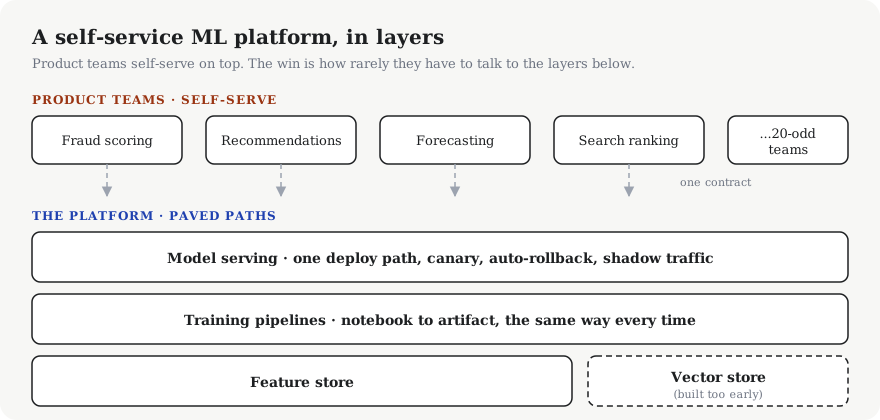
The platform is the bottom three layers. The teams live on top, and the win is how rarely the two have to talk.
A feature store, so teams stopped recomputing the same user and merchant features in slightly different, slightly wrong ways. Standardized training pipelines, so a model went from notebook to artifact the same way every time and we could actually reason about what was running. A model serving layer with one deploy path, one rollout pattern, one place to roll back. Later came a vector store, because retrieval and embedding workloads showed up across enough teams that running them ad hoc had become its own tax.
None of those layers is novel. The bet was never in the components but in the contract: a paved path good enough that a team’s fastest route to production ran straight through it instead of around it.
What it got right
The platform worked because we built it as roads, not rules. We never mandated the feature store; we just made it the path of least resistance and let the mandate stay implicit. If pulling a precomputed feature was two lines and recomputing it yourself was a day of plumbing plus a backfill job plus a monitoring story you had to invent, people pulled the feature. The standard won because it was easier, not because a committee blessed it.
Standardized serving was the highest-leverage move we made. One deploy path meant one set of safety properties for everyone. Canary rollout, automatic rollback on error-rate regression, shadow traffic before anything took real load. We built that once, carefully, and every team inherited it whether they understood it or not. The fraud team that shipped without telling me got a safe rollout for free, because safe was the default and they would have had to work to opt out of it.
Deploy friction came down hard. The cost of getting a model from trained to serving, measured honestly in engineer-days, fell by something close to a third over those two years. We did not get there by writing faster code but by deleting steps. Every handoff between the modeling team and my platform team was a place a model could sit for a week, and we removed most of the handoffs.
What it got wrong
The failures in platform work do not announce themselves as crashes; they are the systems you built beautifully and nobody wanted, and you do not find out for a year.
We built the vector store too early. We saw embedding workloads coming, got excited (it was 2023, everyone was excited), and stood up a dedicated, well-operated vector serving layer ahead of real demand. For most of a year it served two teams who would have been completely fine with the vector extension on the Postgres they already had. We carried the operational weight of a system sized for a wave that had not arrived. The lesson was not that vector stores are bad, but that platform teams are supposed to pave roads people already walk, and we paved one into a field because we could see a town might be built there someday.
The deeper mistake was over-abstraction. We had a theory that every model was an instance of a general shape (features in, training run, artifact out, served behind an endpoint) and we built abstractions to match the theory. They were elegant, but they were also a wall. A team with a model that did not fit the shape, a streaming feature, an odd serving requirement, a latency budget our generic path could not hit, had two options: contort their problem to fit our abstraction, or fork off the platform entirely. Some forked, and each fork was a small indictment. The abstraction that was meant to serve everyone had started deciding which problems were allowed to exist.
The fix, when we finally admitted it, was to expose the layers underneath the abstraction. Let a team drop down to the raw serving primitive when the paved path did not fit, instead of forcing the choice between conformity and exile. A good platform is not a single interface but a paved road with marked exits, and you have to design the exits as deliberately as the road.
The only metric that mattered
We tracked the usual metrics. Adoption, models in production, the deploy-cost number I am proud of. They were all real and they all missed the point.
The honest measure of a self-service platform is how often the platform team is in the loop on a launch. Early on we were in every loop, because nothing shipped without us. Success was watching that number fall toward zero while the number of models shipped climbed. The fraud model I never heard about was not a process failure but the platform doing exactly what we built it for: optional for the ordinary case, and needed only for the genuinely hard ones, the new layer, the new safety property, the team whose problem did not fit yet.
That is the uncomfortable success condition. You build something whose victory looks like your own absence. The org ships more models and talks to you less. If your platform’s health depends on teams needing you, then you did not build a platform at all; you built a service desk with better branding, and you are still the bottleneck, only a more expensive one.
Would I make the bet again? Yes, and earlier, and with fewer abstractions. The roads paid for themselves. The cages I built by accident I had to tear down one at a time, and the teams remembered every one of them. What I took from two years of this is simple enough: the road worth building is the one people are already walking, the exits matter as much as the road, and the only honest measure of the work is how rarely anyone has to come find me.